In short
Most people quit voting advice questionnaires before finishing, so they never learn how reliable their early candidate matches are. A method that predicts their remaining answers estimates that reliability well, and showing people a simple preview of their likely matches kept them answering longer.
Key findings
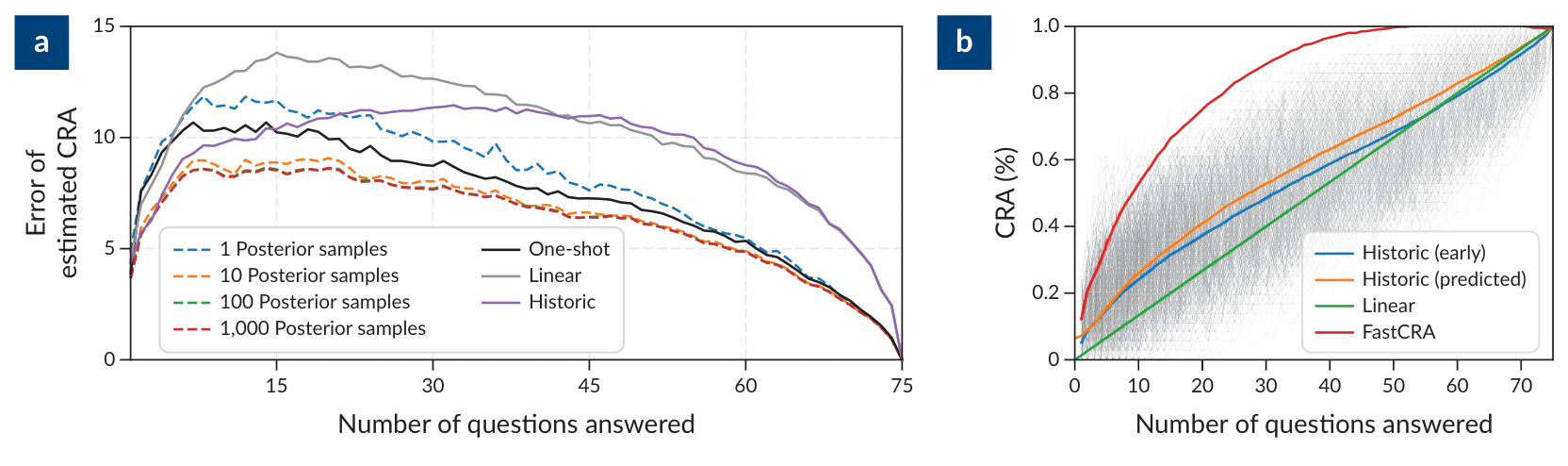
- A method that simulates how a voter would answer the remaining questions estimates the accuracy of early candidate recommendations in a voting advice application to within 6.28% on average, compared with 10.22% for a linearly growing progress bar.
- In a user experiment, voting advice application users shown a preview of their likely candidate recommendations answered significantly more questions before quitting than a control group (68 vs 56 of 75 on average).
- Voting advice application users shown an artificially inflated certainty score stopped answering sooner (49 questions on average) than users shown the real estimate (63), even though they said the display did not influence their decision.
- Voting advice application users understood a simple list of likely candidate matches significantly better than a version that also showed each candidate's match probability as a percentage.
Abstract
Voting advice applications typically require users to answer questionnaires before receiving party or candidate recommendations. As users answer more questions, the recommendations naturally become more accurate. However, when users do not complete the questionnaire, the certainty of these recommendations is unknown. In this work, we develop and present a measure to quantify this certainty by introducing an algorithm that estimates the candidate recommendation accuracy—the overlap between early and final recommendations—after each question.
Figure
Cite
@article{bachmann2026estimating,
  title={Estimating the Recommendation Certainty in Candidate-Based Voting Advice Applications},
  author={Bachmann, Fynn and van der Weijden, Daan and Sarasua, Cristina and Bernstein, Abraham},
  journal={Politics and Governance},
  volume={14},
  year={2026},
  doi={10.17645/pag.11256}
}